{{ heroLeadA }}
{{ heroLeadB }}
{{ heroBody }}
{{ pl.t }}
{{ t.howA }}
{{ t.howB }}
{{ t.howIntro }}
{{ t.rangeA }}
{{ t.rangeB }}
{{ maker.name }}
{{ maker.line }}
{{ panelNote }}
{{ notDoes.h }}
{{ notDoes.lead }}
{{ notDoes.close }}
“{{ q.quote }}”
{{ u.makerH }}
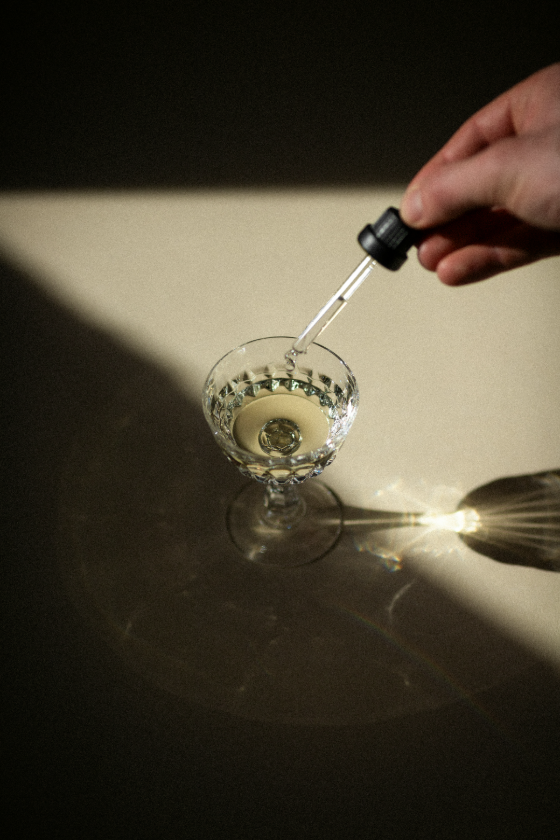
{{ u.makerP1 }}
{{ u.makerP2 }}
{{ t.storeTitle }}
{{ t.storeLedeP1 }}
{{ t.storeLedeP2 }}
{{ t.storeLedeP3 }}
{{ pair.name }}
{{ u.pairBlurb }}
Amplio {{ pName }}
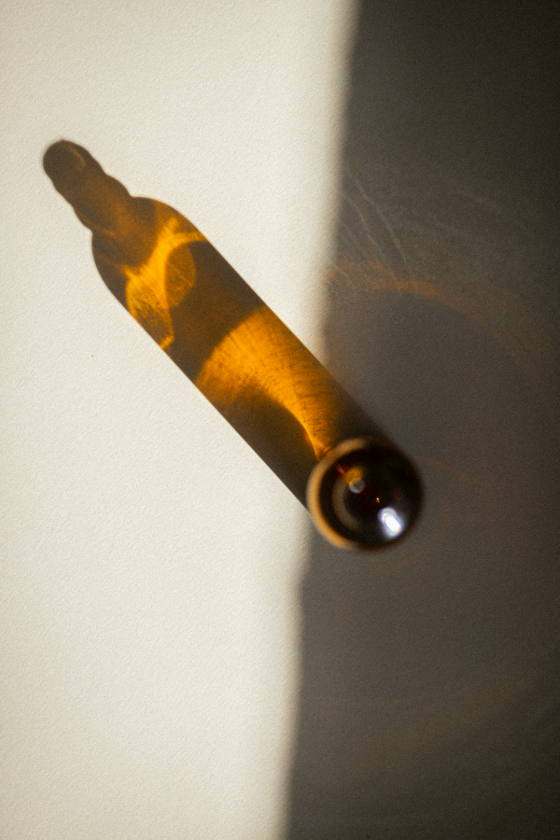
{{ pBlurb }}
{{ u.batchP1 }}
{{ u.batchP2 }}
{{ notDoes.h }}
{{ notDoes.lead }}
{{ notDoes.close }}
{{ f.a }}
Every year the wine industry pours away what is still perfectly good.
The research project Återvin aims to repurpose old wines sustainably — addressing the environmental impact of discarded wine, and the substantial volume wasted every year.
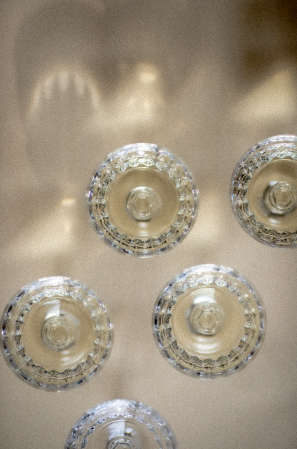
Mushroom, sea and forest — read as flavour, not as garnish.
By incorporating ingredients like mushrooms and flavors from the sea and forest, Återvin enriches discarded wines with new taste profiles. Anders Crichton-Fock seeks to revolutionize sustainability in the wine industry, rescuing wines from disposal and simultaneously creating delightful new flavor experiences.
Amplio is the part of that work you can hold: a 35 ml elixir, concentrated from three Swedish biotopes, that does in a glass what the lab does in a vat.

Lecturer, researcher, and stubborn about waste.
Amplio Drops is a product from Återvin, founded by Anders Crichton-Fock — specializing in transforming the taste of wine to rescue old bottles and create a novel wine experience.
Crichton-Fock, a university lecturer at Örebro University, conducts research on sustainable food, beverages and wine. In the lab he blends wines with deviations or those unsellable, experimenting with ingredients like chamomile, cardamom and batak pepper to salvage and create unique flavors.
“{{ q.quote }}”
Three pillars. One drop.
A wine loses its shape in three places at once — aroma, balance, umami. Amplio Drops works on all three, using mechanisms documented in a hundred and eighteen years of published taste science.
Nothing on this page is a trade secret. Every mechanism links to a paper you can read yourself.
The molecules the wine has lost.
Linalool for florals. γ-butyrolactone for the coconut edge of oak. Sotolone — one of the most odour-active molecules ever measured — for the maple and curry lift.
Aisala et al. 2019 · Wood et al. 2012
What comes forward when the fruit steps back.
When fruit fades, bitterness and astringency are what remain. They were always there, only outweighed. Salt suppresses bitterness; umami compounds do the same. Putting balance back is partly a matter of pushing bitterness down again.
Keast & Breslin 2003, Food Quality and Preference 14(2)
Savoury depth, twice over.
Free glutamate from Nordic fungi meets marine inosinate for the classic 1 + 1 = 8 synergy — plus a newer, VOC-mediated allosteric enhancement of the T1R1/T1R3 receptor itself.
Yamaguchi 1967 · Zhao et al. 2025
Wines lose their shape differently.
A wine that has faded has not faded evenly. An oxidised white loses its fruit while its savoury notes grow. A thin red keeps its balance but has nothing to hold. What is missing decides what has to be put back.
These are shapes of absence, not measurements of effect. What the drops move awaits the blind panel.
Not magic. Dose response.
Choose a dose. The intensity index below reflects how much aromatic and savoury signal one, two or three drops delivers into a 150 ml glass — measured in relative aroma units against the untreated wine.
Sensory response is non-linear: three drops is not three times one drop, because receptor saturation and aromatic threshold effects both plateau early.
Sotolone exists in two mirror-image forms. The S form is detectable at 0.8 micrograms per litre; the R form needs 89. Same molecule, same formula, a hundredfold difference in what a nose can find.
This is why composition is not the same as chemistry. Knowing which compound to add is only half of it — the form it takes decides whether anyone notices.
Pons et al. 2008, Journal of Agricultural and Food Chemistry 56(5)
A hundred and eighteen years of taste science stands behind these drops.
Kikunae Ikeda identifies umami as a distinct basic taste, isolating monosodium glutamate from kombu broth.
Yamaguchi quantifies the glutamate + inosinate synergy — the classic 1 + 1 = 8 curve.
Wood et al. map the biochemical pathway that generates sotolone in dried Lactarius mushrooms — the maple-syrup molecule with one of the lowest known olfactory thresholds.
Aisala et al. characterise the odour-contributing volatiles of Nordic wild edible mushrooms via HS-SPME-GC-MS.
Zhao et al. show that aromatic volatiles allosterically modulate the T1R1/T1R3 umami receptor — savoury depth is not purely a matter of amino acids.
Amplio Drops consolidates these strands into a wine elixir designed to return fruit, length and balance to a glass that has lost them.
You do not have to take our word for it. Read the papers.
- Aisala, H., Sola, J., Hopia, A., Linderborg, K. M., & Sandell, M. (2019). Odor-contributing volatile compounds of wild edible Nordic mushrooms. Food Chemistry, 283, 566–578. doi.org/10.1016/j.foodchem.2019.01.053
- Wood, W. F., Brandes, J. A., Foy, B. D., Morgan, C. G., Mann, T. D., & DeShazer, D. A. (2012). The maple syrup odour of the "candy cap" mushroom, Lactarius fragilis var. rubidus. Biochemical Systematics and Ecology, 43, 51–53. doi.org/10.1016/j.bse.2012.02.027
- Zhao, Y., Zhang, J., Zhao, M., Zhao, X., & Su, G. (2025). Meaty aroma compounds enhance MSG umami perception through allosteric modulation of the T1R1/T1R3 receptor. Foods, 14(17), 3041. doi.org/10.3390/foods14173041
- Combet, E., Henderson, J., Eastwood, D. C., & Burton, K. S. (2006). Eight-carbon volatiles in mushrooms and fungi: properties, analysis, and biosynthesis. Mycoscience, 47(6), 317–326.
- Fogarasi, M., Socaci, S. A., Dulf, F. V., Diaconeasa, Z. M., Fărcaș, A. C., Tofană, M., & Semeniuc, C. A. (2018). Bioactive compounds and volatile profiles of five Transylvanian wild edible mushrooms. Molecules, 23(12), 3272. doi.org/10.3390/molecules23123272
- Li, W., Zi, L., Xu, N., Yang, H., Dong, S., Qin, F., & Guo, L. (2024). Identification of characteristic flavor compounds of Boletus edulis from different regions based on E-nose, HS-GC-IMS and HS-SPME-GC–MS. Food Chemistry: X, 23, 101601. doi.org/10.1016/j.fochx.2024.101601
- Silva Ferreira, A. C., Hogg, T., & Guedes de Pinho, P. (2003). Key odorants related to oxidation-spoiled white wines. J. Agric. Food Chem., 51(5), 1377–1381. doi.org/10.1021/jf025847o
- Poojary, M. M., Orlien, V., Passamonti, P., & Olsen, K. (2017). Enzyme-assisted extraction of umami taste amino acids from cultivated mushrooms. Food Chemistry, 234, 236–244.
- Pons, A., Lavigne, V., Landais, Y., Darriet, P., & Dubourdieu, D. (2008). Distribution and organoleptic impact of sotolon enantiomers in dry white wines. Journal of Agricultural and Food Chemistry, 56(5), 1606–1610. doi.org/10.1021/jf072337r
- Wang, J., Wang, D., Huang, M., Sun, B., Ren, F., Wu, J., Zhang, J., Li, H., & Sun, X. (2024). Decoding the molecular mechanism underlying human olfactory receptor OR8D1 activation by sotolone enantiomers. Journal of Agricultural and Food Chemistry, 72(10), 5403–5415. doi.org/10.1021/acs.jafc.3c09142
- Keast, R. S. J., & Breslin, P. A. S. (2003). An overview of binary taste–taste interactions. Food Quality and Preference, 14(2), 111–124. doi.org/10.1016/S0950-3293(02)00110-6
Now try it in a glass of your own.
{{ u.cartTitle }}
{{ u.emptyTitle }}
{{ u.checkout }}
{{ payError }}
{{ u.thankYou }}
{{ u.confirmBody }}
{{ u.deliveringTo }}{{ orderCountry }} · {{ orderTotal }}
{{ u.orderChecking }}
{{ u.orderMissingTitle }}
{{ u.orderMissingBody }}
{{ u.waitH }}
{{ u.waitLead }}
{{ u.waitNote }}
Questions about the drops, the research, or stocking Amplio.
Write to us and we answer within two working days. For press and research enquiries, mention it in the subject line.
{{ formError }}
Crichton-Fock Innovation AB
Tavastgatan 35
118 24 Stockholm
Sweden
The work behind the drops.
Press coverage of Återvin and Amplio, and two decades of peer-reviewed research on wine, sensory perception and the language of tasting.
{{ u.methodH }}
{{ u.methodP1 }}
{{ u.methodP2 }}
{{ u.methodP3a }}{{ u.methodP3KTH }}{{ u.methodP3b }}{{ u.methodP3Oru }}{{ u.methodP3c }}{{ u.methodP3Rew }}{{ u.methodP3c2 }}{{ u.methodP3Upc }}{{ u.methodP3d }}
{{ u.dropsH }}
{{ u.dropsP1 }}
{{ u.dropsP2 }}
{{ u.dropsP3a }}{{ u.dropsP3Served }}{{ u.dropsP3b }}
{{ u.dropsP4 }}
{{ legalTitle }}
{{ legalIntro }}
{{ sx.expressNote }}
{{ shipDutiesLine }}
{{ shipDutiesJa }}
{{ sec.h }}
{{ para.t }}
For the people who pour.
Amplio was built in a research kitchen and tested across a room of sommeliers. Restaurants, wine schools and specialist retailers order direct, by the case, with trade terms.
{{ u.h }}
{{ u.b }}
{{ sampleCase.name }}
Both references and the sensory protocol sheet, sent to the venue. One per account, and the cost is credited against your first case order.
Trade pricing is quoted per account and depends on volume, market and whether staff training is included. Invoicing is 30 days net once an account is opened.
{{ inc.b }}
Tell us where you pour.
{{ formError }}
{{ u.bandTitle }}
{{ u.footNewsBlurb }}
{{ u.cookieBody }}
{{ u.ageTitle }}
{{ u.ageLead }}
{{ ageFail }}